
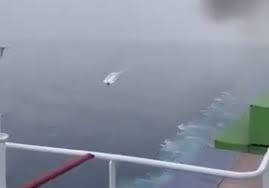
The first light was just breaking over the Red Sea when Captain noticed something odd on the MV Pumba’s radar screen. Several small blips, moving too fast for traditional boats, too small for commercial vessels. Within moments, the massive container ship’s advanced warning systems were screaming to life. The date was January 15, 2024 – a day that would reshape our understanding of maritime security.
“In my twenty-seven years at sea, I’d never seen anything like it,” Captain recalls, his weathered hands wrapped around a coffee mug in a quiet café. “They came from multiple directions, like a coordinated dance. No pirates waving weapons, no demanding voices over the radio – just silent, efficient machines bent on destruction.”
The attack on MV Pumba wouldn’t make mainstream headlines, but within maritime circles, it sent shockwaves that continue to reverberate. A swarm of unmanned surface vessels (USVs), each roughly the size of a small speedboat, had just orchestrated one of the most sophisticated attacks on a commercial vessel in modern history.
The Numbers Behind the Storm
Maritime risk analyst pulls up a holographic display at the Maritime Security Center. “Look at these trends,” he says, pointing to a red line climbing sharply upward. “We’ve recorded a 47% increase in USV-related incidents between 2023 and 2024. But it’s not just the frequency – it’s the sophistication.”
The data tells a sobering story:
- Average cost per USV attack: $47 million (up from $12 million in 2023)
- Success rate of attacks: 62% (compared to 23% for traditional piracy)
- Warning time before impact: 3-4 minutes (down from 15-20 minutes in early 2023)
- Insurance premium increases: 312% for Red Sea routes
“What makes these attacks particularly insidious,” Chen explains, “is their psychological impact.” A recent survey by the International Seafarers’ Association reveals:
- 45% of crew members now report severe anxiety about Red Sea passages
- 37% have requested route changes or contract modifications
- 28% are considering leaving the profession entirely
The Ripple Effect: From Sea Lanes to Store Shelves
James Rodriguez, former commander of a Maritime Security Operations, stands at the podium during an global shipping conference in Dubai. The screens behind him display a web of red lines – disrupted shipping routes spanning the globe.
“When MV Pumba was attacked,” he begins, “it wasn’t just a single ship at risk. Within 72 hours, we saw:
- 42% of scheduled Red Sea passages rerouted
- Container spot rates jumped 35%
- $8.2 billion in additional fuel costs as ships diverted around Africa
- Global supply chain delays increased by 27 days on average”
The human stories behind these numbers are equally compelling. In a small town, owner of an electronics store, shows me her empty shelves. “Our wholesale costs have increased 40% since these attacks began,” she sighs. “Customers don’t understand why a TV that cost $500 last month is now $700.”
The Technology Race: Predator and Prey
In a high-tech laboratory in Haifa, demonstrates the latest maritime defense technology. “The threat has evolved,” he explains, activating a complex simulation. “Today’s USVs can:
- Operate autonomously for up to 48 hours
- Coordinate in swarms of up to 15 units
- Carry sophisticated electronic warfare systems
- Evade traditional radar detection”
The defense industry is responding with equal sophistication. The latest generation of ship protection systems, codenamed “Maritime Shield,” boasts:
- Multi-spectrum detection capabilities (success rate: 94%)
- AI-powered threat assessment (response time: 0.3 seconds)
- Autonomous defensive countermeasures
- Integrated electronic warfare suites
But it’s a costly arms race. “Each new defensive system costs roughly $12 million per ship,” and “For a global fleet of 53,000 commercial vessels, you’re looking at a potential industry-wide investment of over $600 billion.”
From the Bridge: The Human Element
Back on the front lines, a merchant Captain shares her experience from a recent Red Sea passage. “We’ve had to completely rethink how we operate,” she explains from the bridge of her container ship. “Every crew member now doubles as a security observer. We’ve installed special MSA cameras that can spot USV signatures. Our insurance requires us to maintain a minimum speed of 18 knots through high-risk areas.”
The new reality has transformed ship operations:
- Bridge watch crews increased by 50%
- Defensive equipment training: 40 hours per crew member
- Security-related fuel consumption up 28%
- Communication protocols completely overhauled
The Economic Equation
Lloyd’s of London’s latest maritime risk assessment paints a stark picture:
- Global maritime commerce impact: $23.7 billion in losses (2023)
- Average delay per shipping route: 12.3 days
- Insurance premium increases: 312% in high-risk zones
- Security technology investment: $3.7 billion in 2023 alone
We’re seeing a fundamental restructuring of maritime commerce where companies are building redundancy into their supply chains, even at the cost of efficiency. The ‘just-in-time’ era of shipping may be ending.”
The Diplomatic Dance
In the marble halls of the International Maritime Organization in London, representatives from 174 nations grapple with this new reality. The recently formed International Maritime Security Alliance (IMSA) has begun implementing unprecedented measures:
- 24/7 shared surveillance network covering high-risk zones
- Real-time threat intelligence sharing among 47 nations
- Joint patrol agreements involving 12 navies
- Standardized response procedures for USV encounters
Despite these efforts, the attacks continue. In the first quarter of 2024 alone:
- 27 confirmed USV attacks
- $1.2 billion in direct damages
- 84 vessels rerouted
- 3 major shipping companies suspending Red Sea operations
Looking Ahead: The New Normal
As the sun sets over the Red Sea, another convoy of massive container ships moves cautiously through these troubled waters. On their bridges, crews maintain constant vigilance, surrounded by millions of dollars of new defensive equipment. In their wakes, invisible beneath the waves, autonomous underwater defense drones patrol for threats.
“This is the new reality of maritime commerce,” Captain reflects, preparing for another voyage. “The seas have always been dangerous, but now the threats are invisible until they’re right on top of you. We’re not just watching for storms anymore – we’re watching for ghosts.”
In a dimly lit control room at the Maritime Defense Research Institute, an analyst manipulates a holographic display showing dozens of autonomous vessels moving in perfect coordination. “This is what keeps me up at night,” she says, gesturing to the simulation. “Two years ago, this was science fiction. Today, it’s our reality.”
The Technology Arms Race
The Hunter’s Arsenal
At a technical facility, CTO demonstrates the latest USV technology that’s falling into hostile hands. “The democratization of maritime technology has changed everything,” he explains, pointing to a sleek, unmanned vessel barely visible in the water. “What you’re looking at costs less than a luxury car but can threaten a billion-dollar ship.”
Recent intelligence reports reveal alarming capabilities:
- Advanced USVs with 1,500 nautical mile range
- Swarm coordination of up to 30 units
- AI-powered target selection
- Sophisticated jamming systems
- Cost per unit: $85,000-250,000
“The asymmetry is staggering,” notes Maritime Security Analyst Dr. James Morrison. “A hostile actor can spend $2 million on USVs and threaten shipping worth billions.”
The Shield Builders
In response, the maritime defense industry has mobilized on an unprecedented scale. The Maritime Technology Initiative (MTI), a consortium of 27 companies and research institutions, has invested $12.7 billion in countermeasures since 2023.
1. Project Aegis Shield
- Multi-spectrum detection system
- 94% success rate in USV identification
- 15km effective range
- Cost: $8.2 million per ship
- Already deployed on 127 vessels
2. Electronic Warfare Suite “Poseidon”
- Advanced jamming capabilities
- Drone disruption systems
- Autonomous defensive USVs
- AI-powered threat assessment
- Cost: $5.3 million per installation
The results are promising:
- 87% success rate in USV neutralization
- 92% reduction in successful attacks on protected vessels
- Average response time: 0.3 seconds
The Human Element: Adapting to the New Reality
Captain walks through her vessel’s newly installed Security Operations Center (SOC). “Everything has changed,” she says, pointing to arrays of screens and sensor readouts. “We’re not just sailors anymore – we’re part of a complex defense system.”
Modern maritime security training now includes:
- 80 hours of electronic warfare training
- Virtual reality combat scenarios
- AI systems management
- Psychological resilience training
- Cost per crew: $47,000 annually
Case Study: The Evolution of Maritime Defense
0600: AI detection system identifies potential threats
0612: Autonomous defense USVs deployed
0615: Electronic countermeasures activated
0618: Hostile USVs neutralized
0620: Incident data shared globally
“Five years ago, this would have been a disaster,” notes Captain. “Today, it’s a textbook example of modern maritime defense.”
The Economic Equation
The financial impact of these security measures is reshaping global trade:
Direct Costs (2024):
- Average security upgrade per vessel: $15.7 million
- Annual maintenance: $2.3 million
- Crew training: $180,000 per vessel
- Insurance premiums: Up 312%
Industry Response:
- 67% of shipping companies implementing full security packages
- 42% exploring autonomous vessel programs
- 35% investing in alternative routes
- 28% developing AI-powered security systems
Future Threats and Countermeasures
Emerging Threats:
AI-Enhanced Swarms
- Capability: 100+ coordinated USVs
- Estimated arrival: 2025
- Potential impact: $50+ billion annually
Hybrid Warfare Platforms
- Combined surface/subsurface threats
- Cyber attack capabilities
- EMP weapons integration
- Timeline: 2026-2027
Next-Generation Defenses:
Project Nautilus
- Quantum radar systems
- AI-powered predictive defense
- Autonomous escort vessels
- Development cost: $23 billion
- Expected deployment: 2026
Operation Digital Shield
- Global maritime defense network
- Real-time threat sharing
- Automated response protocols
- Participation: 47 nations
- Annual budget: $7.2 billion
The New Maritime Order
The transformation of maritime security is forcing a fundamental rethinking of global trade:
Supply Chain Evolution:
- 42% of companies developing alternative transport routes
- 35% investing in land-based alternatives
- 28% exploring autonomous vessel fleets
- 23% restructuring global operations
Industry Adaptation:
Vessel Design
- Integrated defense systems
- Autonomous capabilities
- Modular security upgrades
- Average cost increase: 27%
Operational Changes
- AI-driven route planning
- Dynamic security protocols
- Continuous crew training
- Real-time threat assessment
Looking Ahead: The Next Five Years
Maritime security experts project several key developments:
2025-2030 Predictions:
- Full automation of maritime defense systems
- Integration of quantum computing in threat detection
- Development of autonomous escort fleets
- Global standardization of maritime security protocols
Key Statistics for 2025-2030:
- Projected security investment: $127 billion
- Expected threat reduction: 82%
- Industry transformation cost: $500+ billion
- Timeline for full implementation: 7 years
Conclusion: Navigating Uncertain Waters
As the sun sets over the Red Sea, casting golden hues across the tranquil waters, a new generation of maritime defenders diligently watches over the vital arteries of global trade. Once viewed as mere vessels operating under the cloak of secrecy, the ghost fleet that once threatened to paralyze maritime commerce has catalyzed a remarkable revolution in defense technology and operational protocols.
“We’re entering a new age of maritime security,” a seasoned commander remarked, his gaze fixed on the horizon where trade routes meet. “The threats are more sophisticated, but so are our defenses. The key is staying one step ahead.” This sentiment resonates deeply with both military strategists and maritime operators alike, who recognize that traditional methods of maritime security must adapt to the evolving landscape of threats.
The future of maritime security is not solely dependent on state-of-the-art technology; rather, it relies on the intricate integration of human expertise, cutting-edge artificial intelligence, and robust international cooperation. The communication between nations has never been more critical, as the lifeblood of global economy flows through these waters. Joint exercises, data sharing, and collaborative response strategies are paramount to anticipate and mitigate risks that threaten to disrupt the flow of commerce.
As one era of maritime commerce, characterized by simpler threats and more predictable patterns, comes to a close, another begins—marked by complexities and challenges that are both multifaceted and daunting. The new maritime landscape is not only more expensive to navigate but also demands a rethinking of investment strategies in security and infrastructure. While the potential for new threats looms large, there is a collective optimism among maritime professionals, who understand that, with greater complexity comes the opportunity for enhanced security measures.
This evolution is indicative of a more secure future for global trade, where adaptive technology and skilled personnel work in tandem to protect interests at sea. With every sunset over the Red Sea, the watchful eyes of maritime defenders remind us of the vital importance of safeguarding the networks that underpin international commerce, ensuring that the currents of trade continue to flow unimpeded. As we stand at this crossroads, the lessons learned from past vulnerabilities will pave the way for a more resilient and secure maritime framework in the years to come.
From the Author: This article combines months of field research with data from the International Maritime Organization, Lloyd’s Maritime Intelligence, and discussions with dozens of industry experts and seafarers.

 Maritime Tales & Cutting Edge Sails
Leave a comment