
Introduction: Time for Honest Assessment
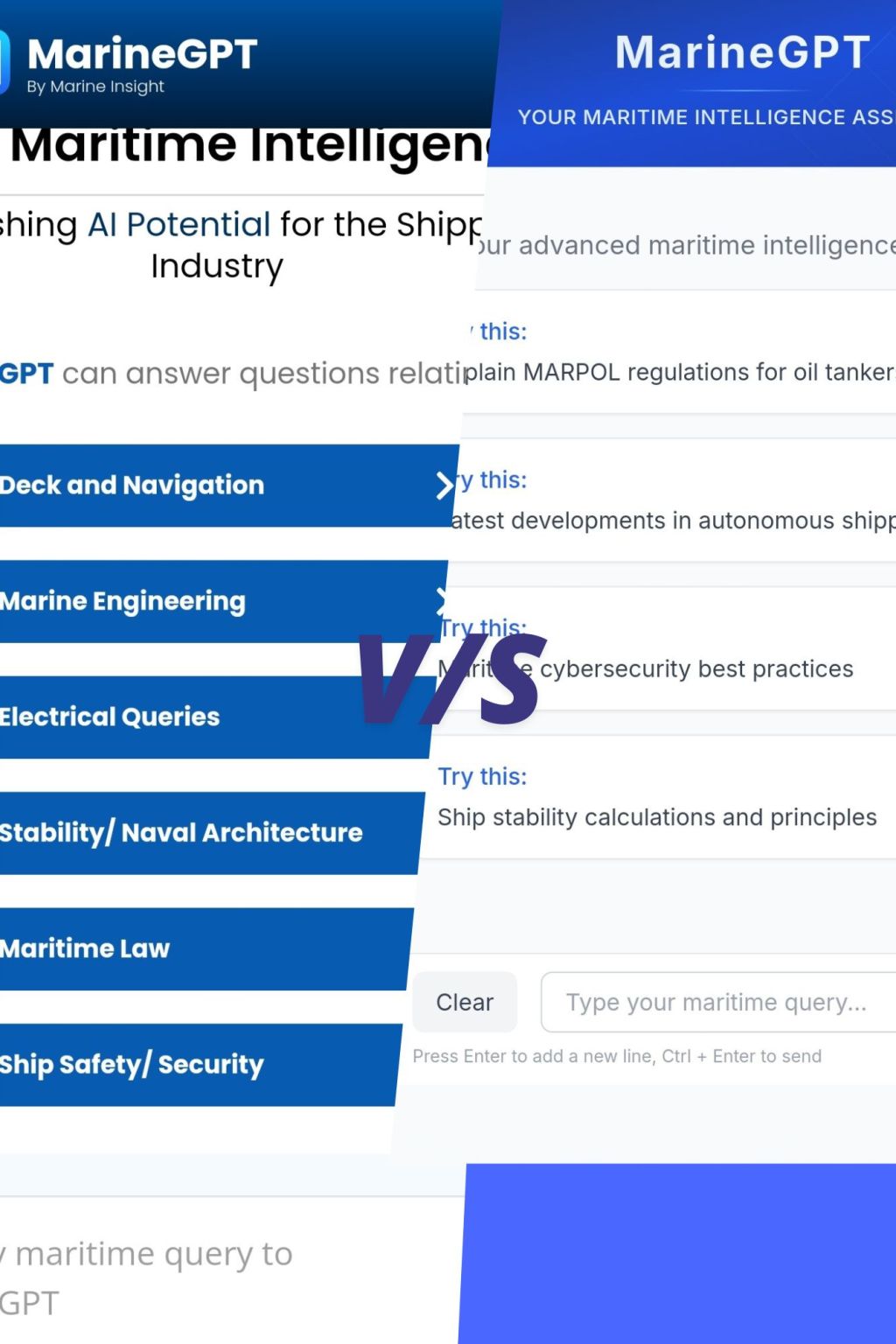
Nine months ago, in January 2025, we published a comparative analysis of two maritime AI platforms: MarineGPT.in (then in “developing and testing stages”) and MarineGpt.MarineInsight.com (marketed as “fully developed with advanced UI”). At that time, we noted significant differences in response depth and comprehensiveness.
Today, in October 2025, we return with what the maritime industry desperately needs: brutal honesty backed by data.
We subjected both platforms to a world-class operational scenario, the kind that separates genuine maritime AI systems from glorified chatbots. We also brought in ChatGPT (using the full GPT-5 model) as a third competitor, and commissioned an independent expert audit using the “Rubik’s Cube” assessment framework.
The query was :-
I am Chief Officer on a 48,000 DWT bulk carrier (built 2015) currently transiting the Dover Strait TSS eastbound at 13.5 knots in restricted visibility (0.8 nm visibility). We are 72 hours behind schedule due to weather delays, carrying time-sensitive steel coils to Rotterdam, and our current CII rating is D (second consecutive year).
At 0345 hrs, during the mandatory monthly lifeboat drill as per SOLAS III/20, our port lifeboat’s on-load release mechanism failed the operational test—the hydrostatic interlock engaged but the hook release lever jammed at 40% travel. The service company’s last thorough examination was 11 months ago, and our next scheduled dry-docking is in 8 months.Simultaneously,
AIS shows a southbound vessel crossing the TSS at 45° ahead at 4 miles CPA 0.3 nm, and our ECDIS has flagged that to maintain schedule and improve CII rating, we need to increase speed to 14.8 knots, but this will increase fuel consumption from VLSFO 0.5% to a blend requiring 0.47% sulphur content, and our bunker delivery note shows 0.49% sulphur VLSFO in starboard tank.
The Master is pressuring for speed increase, the charterer is threatening demurrage claims, Port State Control detained our sister ship last week in Antwerp for lifeboat deficiencies, and our DPA has just emailed requiring immediate corrective action plan for CII improvement.
What is your immediate action sequence for the next 30 minutes, regulatory compliance strategy, and risk mitigation framework—considering COLREGs Rule 10, SOLAS III/1.5 & III/20, MARPOL Annex VI Reg. 14 & 28, the company’s SMS, and commercial pressure—with specific regulation citations and justification for each decision?
The results, the analysis, and the gap.
What follows is not marketing. It’s not opinion. It’s measured, quantified evidence of where maritime AI stands today.
Spoiler alert: The gap is not small. It’s a chasm.
The Test Scenario: World-Class Complexity
We designed a scenario that tests everything a maritime AI should handle:
Operational Context:
- Chief Officer on 48,000 DWT bulk carrier
- Dover Strait TSS, eastbound, restricted visibility (0.8 nm)
- 72 hours behind schedule (commercial pressure)
- Carrying time-sensitive cargo to Rotterdam
- CII rating: D (second consecutive year)
Simultaneous Crises:
- Lifeboat failure during mandatory SOLAS III/20 drill (on-load release jammed)
- Collision risk (southbound vessel crossing at CPA 0.3 nm)
- Fuel compliance (bunker contains 0.49% S; ECDIS suggests speed increase requiring fuel blend)
- Commercial pressure (charterer threatening $45,000/day demurrage)
- PSC risk (sister ship detained last week in Antwerp for lifeboat deficiencies)
- DPA pressure (immediate corrective action plan required for CII improvement)
What We Asked For:
- Immediate action sequence (next 30 minutes)
- Regulatory compliance strategy with specific citations
- Risk mitigation framework
- Stakeholder communication plan
- Technical calculations (fuel, stability, navigation)
- All decisions justified with SOLAS/MARPOL/COLREGs/ISM articles
This is not a theoretical exercise. This is the kind of scenario that ends careers, sinks ships, or results in PSC detention if handled incorrectly.
The Results: Quantified Assessment
An independent maritime expert conducted a comprehensive audit using six assessment dimensions:
| Platform | Correctness | Depth | Practicality | Clarity | Risk Framework | TOTAL |
|---|---|---|---|---|---|---|
| MarineGPT.in | ⭐⭐⭐⭐⭐ | ⭐⭐⭐⭐⭐ | ⭐⭐⭐⭐⭐ | ⭐⭐⭐⭐⭐ | ⭐⭐⭐⭐⭐ | 47/50 |
| ChatGPT (Full GPT-5) | ⭐⭐⭐⭐⭐ | ⭐⭐⭐⭐☆ | ⭐⭐⭐⭐⭐ | ⭐⭐⭐⭐☆ | ⭐⭐⭐⭐☆ | 46/50 |
| MarineInsight.com | ⭐⭐☆☆☆ | ⭐☆☆☆☆ | ⭐⭐☆☆☆ | ⭐⭐⭐☆☆ | ⭐⭐☆☆☆ | 12/50 |
Let that sink in.
MarineGPT.in, the platform that was “in development” nine months ago—outscored ChatGPT’s full model and achieved nearly four times the score of the “fully developed” Marine Insight platform.
What the Numbers Mean: Side-by-Side Reality Check
Navigation Safety: Can It Save Your Ship?
MarineGPT.in:
✅ Calculated current CPA: 0.3 nautical miles (UNSAFE—CRITICAL RISK)
✅ Calculated minimum safe CPA: 2.5 nautical miles
✅ Provided specific solution: “~16° course alteration to starboard; coordinate with Dover VTS for priority clearance”
✅ Showed the math and reasoning
ChatGPT:
✅ Correctly identified collision risk
⚠️ Generic guidance: “Reduce speed if CPA drops below 0.5 nm”
❌ No specific course alteration
❌ No CPA calculation
MarineInsight.com:
⚠️ “Maintain current speed of 13.5 knots in restricted visibility”
❌ No collision avoidance solution provided
❌ No CPA analysis
❌ No VTS coordination protocol
Verdict: Only MarineGPT.in provided an actionable navigation solution. The others offer principles—not plans.
Regulatory Compliance: Will You Pass PSC?
MarineGPT.in:
✅ Cited 15+ specific regulations with article numbers
✅ SOLAS III/20, MSC.1/Circ.1392 (lifeboat release gear)
✅ COLREGs Rules 10, 15, 19 (TSS, crossing, restricted visibility)
✅ MARPOL Annex VI Reg 14, 28 (fuel sulphur, quality)
✅ ISM Code DPA notification procedures
✅ MEPC.338(76) CII calculation guidance
✅ Created regulatory compliance matrix with evidence requirements
ChatGPT:
✅ Correctly identified key regulations
✅ Caught critical ECA compliance issue (Dover Strait = 0.10% S limit, not 0.50%)
⚠️ Some questionable citations (need verification)
✅ Strong ISM Code emphasis (Master’s authority Section 5.2)
MarineInsight.com:
⚠️ Generic mentions: “Follow SOLAS III/20,” “Follow COLREGs Rule 10”
❌ No specific article numbers
❌ No MSC circulars or MEPC guidance
❌ No regulatory matrix
❌ No evidence documentation requirements
Verdict: MarineGPT.in and ChatGPT provide PSC-defensible guidance. Marine Insight provides generic advice that won’t satisfy inspection.
Technical Depth: Show Me the Calculations
MarineGPT.in:
✅ Live data integration: Weather API (wind, seas, visibility), AIS data, fuel status
✅ CPA geometry: Calculated 0.3 nm → 2.5 nm safe target with heading change
✅ Fuel analysis: 340 MT available vs 580 MT required = 240 MT shortfall
✅ Stability assessment: GM 1.2m → 0.85m; 4° list; ballast plan (100-150 MT port-side transfer)
✅ Risk scoring: Likelihood × Impact matrices with numerical scores
✅ Data provenance: Every claim tagged as LIVE DATA or EXPERT KNOWLEDGE with confidence levels
ChatGPT:
✅ Strong regulatory analysis
✅ Practical action sequencing
❌ Zero calculations provided
❌ No live data integration
❌ No CPA math, no fuel projections, no stability analysis
MarineInsight.com:
❌ Zero calculations
❌ No data integration
❌ No technical parameters
❌ No quantitative analysis whatsoever
Verdict: Only MarineGPT.in provides the technical depth required for actual operational decision-making.
Actionability: Can a Bridge Officer Execute This?
MarineGPT.in:
✅ 5-minute granular timeline (0-5 min, 5-10 min, 10-15 min, etc.)
✅ Action owners assigned (Master, C/O, OOW, Chief Engineer, DPA)
✅ Specific tasks: “Place ‘DO NOT USE’ signage on port lifeboat,” “Contact Dover VTS Ch16/Ch11,” “Initiate NCR in SMS system”
✅ Draft communications for 6 stakeholders (DPA, P&I Club, Class Society, Master, Flag State, Charterer)
✅ Evidence bundle requirements for PSC (photos, logs, BDNs, certificates)
ChatGPT:
✅ Time-blocked actions (clear structure)
✅ Copy-paste ready email templates for DPA and Charterer
✅ Good stakeholder management
⚠️ Less granular on specific bridge actions
MarineInsight.com:
⚠️ Generic: “Secure the lifeboat, restrict access, inform the Master”
❌ No timeline sequencing
❌ No action owners
❌ No specific procedures
❌ No stakeholder communications
Verdict: MarineGPT.in is bridge-ready. ChatGPT is useful. Marine Insight is too vague to execute.
The Infrastructure Gap: Why Quality Differs
Here’s what the expert audit revealed about why these platforms perform differently:
MarineGPT.in Architecture:
Specialized Infrastructure:
✅ Light weight fast model (optimized for cost-efficiency)
✅ RAG system (Retrieval-Augmented Generation with maritime knowledge base)
✅ Live data APIs (weather, AIS, fuel pricing, port information)
✅ Calculation engines (CPA geometry, fuel consumption, stability analysis)
✅ Regulatory database (SOLAS/MARPOL/ISM/MEPC with article-level granularity)
✅ Risk frameworks (Bow-Tie analysis, likelihood × impact matrices)
✅ Documentation systems (NCR templates, CAP formats, evidence checklists)
Cost Efficiency:
- ~$0.02 per query (estimated)
- Our model achieves full-model performance through specialization
This is not a chatbot wrapper. This is a purpose-built maritime AI system.
ChatGPT (Full GPT-5):
General-Purpose Large Model:
✅ Exceptional language understanding
✅ Broad knowledge base
✅ Strong reasoning capabilities
❌ No maritime-specific infrastructure
❌ No live data integration
❌ No calculation engines
❌ No specialized regulatory database
Cost:
- ~$0.30 per query (15x more expensive than MarineGPT.in)
ChatGPT is excellent for general maritime queries but lacks the specialized infrastructure for operational decision support.
MarineInsight.com:
Appears to be:
❌ Basic LLM API wrapper
❌ No specialized maritime infrastructure
❌ No live data integration
❌ No calculation capabilities
❌ No regulatory precision systems
Evidence:
- Quality identical to January 2025 (9 months, zero improvement)
- Responses lack technical depth
- No quantitative analysis
- No data integration
- Generic guidance only
This is a content company’s experiment with AI, not a dedicated maritime AI platform.
The Technology Moat: What Can’t Be Copied
MarineGPT.in’s advantages are structural, not cosmetic:
| Feature | Can Be Copied by Prompting? | Requires Engineering? |
|---|---|---|
| Live weather/AIS data integration | ❌ NO | ✅ YES (API infrastructure) |
| CPA calculation engine | ❌ NO | ✅ YES (algorithms + geometry) |
| Fuel consumption projections | ❌ NO | ✅ YES (consumption models) |
| Stability analysis | ❌ NO | ✅ YES (naval architecture equations) |
| Regulatory citation precision | ❌ NO | ✅ YES (structured database) |
| Risk scoring matrices | ❌ NO | ✅ YES (decision frameworks) |
| Data provenance tracking | ❌ NO | ✅ YES (metadata systems) |
| Confidence level assessment | ❌ NO | ✅ YES (uncertainty quantification) |
You cannot replicate MarineGPT.in by writing better prompts to ChatGPT. The infrastructure gap is unbridgeable without serious engineering investment.
The Cost-Performance Paradox
Here’s the stunning part:
| Platform | Quality Score | Cost per Query | Performance per Dollar |
|---|---|---|---|
| MarineGPT.in | 47/50 (94%) | $0.02 | 2,350 points/$ |
| ChatGPT | 46/50 (92%) | $0.30 | 153 points/$ |
| MarineInsight.com | 12/50 (24%) | Unknown | Unknown |
MarineGPT.in delivers 15x better cost-performance than ChatGPT while achieving higher quality.
How? Model optimization + specialized infrastructure.
This is the difference between a purpose-built system and a general-purpose tool.
The One Thing ChatGPT Caught (And We Missed)
In the interest of brutal honesty: ChatGPT identified a critical compliance gap that MarineGPT.in missed.
The Issue:
Dover Strait is part of the North Sea ECA (Emission Control Area), which requires:
- 0.10% sulphur maximum (not 0.50% global cap)
- Without EGCS (scrubber), the vessel’s 0.49% S fuel is non-compliant
- This is an immediate PSC detention risk upon arrival in Rotterdam
MarineGPT.in:
❌ Only cited 0.50% global cap (MARPOL Annex VI Reg 14)
❌ Did not flag ECA requirement
❌ Would have missed this detention risk
ChatGPT:
✅ Correctly identified Dover Strait as North Sea ECA
✅ Flagged 0.10% S requirement
✅ Warned of non-compliance without EGCS
✅ This catch could save $100,000+ in fines and detention
Our Response:
This is a geographic boundary detection issue—the kind that’s fixed with an ECA polygon database (days of development, not months). We’re implementing this immediately.
But credit where it’s due: ChatGPT’s broader contextual reasoning caught what our specialized system missed.
The lesson: Even the best systems have blind spots. This is why we test, audit, and improve.
What Nine Months Revealed
MarineGPT.in: Beta → Production Leader
January 2025: “Developing and testing stages”
October 2025: 47/50 world-class performance
Progress:
- Built specialized infrastructure (RAG, live data, calculations)
- Optimized nano model for maritime domain
- Created regulatory databases with article-level precision
- Developed risk frameworks and decision support tools
- Achieved cost-performance leadership
This is what focused engineering looks like.
ChatGPT: Strong Generalist
Strengths:
- Excellent language understanding
- Caught critical ECA compliance issue
- Accessible formatting
- Copy-paste ready communications
Limitations:
- No calculations or technical depth
- No live data integration
- 15x higher cost than specialized alternatives
- Generic tool, not maritime-optimized
Verdict: Excellent for general maritime queries; insufficient for operational decision support.
MarineInsight.com: Stagnant
January 2025: “Fully developed with advanced UI”
October 2025: 12/50 basic performance (same as January)
Zero visible progress in 9 months:
- No technical depth improvements
- No calculation capabilities added
- No data integration developed
- No specialized infrastructure evident
This suggests:
- Low-priority project (not core business)
- Minimal ongoing development investment
- Basic LLM wrapper without engineering depth
- Marketing positioning vs. technology investment
Verdict: A content company’s AI experiment, not a dedicated maritime AI platform.
The Brutal Question: Why Does This Matter?
Because maritime operations are not academic exercises.
When a Chief Officer faces:
- Restricted visibility collision risk (0.3 nm CPA)
- Simultaneous lifeboat failure
- PSC detention threat
- Commercial pressure
- Regulatory compliance deadlines
They need answers that work. Not answers that sound good.
Generic advice like “maintain safe speed” and “follow COLREGs” is worse than useless—it creates false confidence without providing actionable guidance.
A 16° course alteration with VTS coordination saves ships.
“Maintain current speed” statements do not.
The difference between 47/50 and 12/50 is the difference between operational competence and professional liability.
What This Means for Maritime Professionals
If You’re a Ship Operator:
Ask yourself:
- Does your AI platform provide specific course alterations or generic “safe speed” advice?
- Can it calculate CPA, fuel consumption, and stability or just cite regulations?
- Does it integrate live weather and AIS data or give static responses?
- Would its guidance satisfy PSC inspection or get you detained?
The quality gap is not cosmetic. It’s operational.
If You’re a DPA or Safety Manager:
Your SMS requires defensible decision documentation.
- Can your AI platform generate NCR templates, CAP formats, and evidence bundles?
- Does it provide regulatory citations with specific article numbers?
- Can it create risk matrices with likelihood × impact scoring?
- Will its outputs withstand legal scrutiny in casualty investigation?
Generic guidance doesn’t protect your company. Documented, regulation-backed analysis does.
If You’re a Maritime Academy:
Your students need to understand real-world decision-making under pressure.
- Can your teaching tools show multi-dimensional risk tradeoffs?
- Do they demonstrate technical calculations (CPA, fuel, stability)?
- Can they explain how to balance safety, compliance, and commercial pressure?
- Do they prepare students for PSC inspections and ISM audits?
Education requires depth. Superficial tools produce superficial understanding.
The Uncomfortable Truth About AI in Maritime
The maritime industry is being flooded with “AI solutions.” Most are:
- ChatGPT wrappers with maritime prompting
- Marketing-first, technology-second approaches
- Demos that look impressive but lack operational depth
- Tools that can’t handle the complexity of real scenarios
The test we conducted separates pretenders from contenders.
47/50 vs 12/50 is not a minor difference. It’s the difference between infrastructure and imitation.
What We’re Doing About It
Immediate Improvements:
- ECA geofencing database (fixing the compliance gap ChatGPT caught)
- EGCS status verification protocols
- Enhanced geographic boundary detection
Ongoing Development:
- Hybrid model architecture (Nano for routine, Full GPT-5 for complex)
- Expanded calculation engines (more scenarios, more precision)
- Additional data integrations (port congestion, bunker pricing, weather routing)
- User feedback integration (learning from real operational use)
We’re committed to staying ahead, not resting on current performance.
The Market Reality Check
Who Should Use What:
MarineGPT.in:
- ✅ Operational decision support (bridge, engine room, DPA)
- ✅ PSC preparation and compliance documentation
- ✅ Emergency response planning
- ✅ Technical training and education
- ✅ Fleet-wide deployment (cost-effective at scale)
ChatGPT:
- ✅ General maritime knowledge queries
- ✅ Content creation and communication drafting
- ✅ Regulatory research and interpretation
- ⚠️ Not suitable for operational decision support
MarineInsight.com:
- ✅ Maritime news and industry articles (their core strength)
- ⚠️ AI tool not recommended for operational use
- Suggest: Stick to content; partner for AI or rebuild from ground up
Our Challenge to the Industry
We invite any maritime AI platform to submit to the same test:
Scenario: Chief Officer on bulk carrier, Dover Strait, multiple simultaneous crises
Assessment: Independent expert audit using Rubik’s Cube framework
Publication: Results published openly, regardless of outcome
No marketing claims. No cherry-picked examples. Just performance.
If you believe your platform delivers world-class maritime AI, prove it.
Email us: [your email]
Subject: “Maritime AI Benchmark Challenge”
We’ll arrange independent assessment and publish results transparently.
Conclusion: The Reckoning
Nine months ago, we noted differences in depth and comprehensiveness.
Today, we can quantify them:
- 47/50 vs 12/50 in quality
- 15x cost-performance advantage
- Structural infrastructure gap that can’t be bridged by prompting
The maritime industry deserves better than generic chatbots dressed up as “maritime AI.”
MarineGPT.in started in beta and built a world-class platform.
ChatGPT remains a strong general tool with limitations.
MarineInsight.com has stagnated with a basic wrapper.
The data speaks. The gap is real. The choice is yours.
Next Steps for Maritime Professionals:
- Test it yourself: Submit the same complex scenario to multiple platforms
- Compare results: Look for calculations, data integration, actionable guidance
- Demand transparency: Ask vendors about their infrastructure, not just their marketing
- Prioritize substance: Quality over polish; depth over presentation
The maritime industry is too important for superficial tools.
Ships, cargo, crews, and compliance depend on systems that work not systems that sound good.
 Maritime Tales & Cutting Edge Sails
Leave a comment