
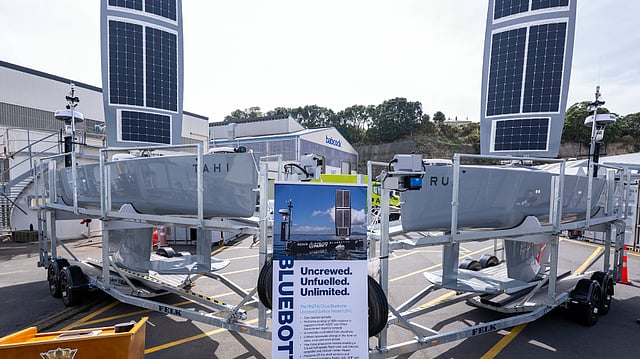
In a landmark move for maritime security, New Zealand unveiled two uncrewed surface vessels (USVs), Tahi and Rua, on April 15, 2025, at Devonport Naval Base. These Bluebottle-class vessels, developed by Sydney-based Ocius Technologies, mark a transformative leap in combating transnational crime, particularly drug smuggling, across New Zealand’s vast 4.3 million km² exclusive economic zone (EEZ). Powered by renewable energy and equipped with advanced sensor suites, these autonomous platforms are not just tools for today but harbingers of a future where mass-scale, uncrewed surveillance redefines maritime operations. This article explores the technical innovations, operational impacts, and the broader implications of Tahi and Rua, exploring how they pave the way for next-generation autonomous maritime systems.
The Bluebottle USVs, measuring 7.4 meters in length, are engineering marvels designed for endurance and autonomy. Their propulsion system harnesses solar panels, a rigid photovoltaic sail for wind, and wave motion, achieving a normal operational speed of 2–3 knots and a maximum of 5 knots. A backup motor ensures functionality in low-wind or no-sunlight conditions, enabling continuous operations for weeks or months without refueling. This renewable energy architecture eliminates the fuel costs that burden traditional crewed vessels, offering a sustainable and cost-effective solution for persistent maritime surveillance. Controlled remotely from HMNZS Matataua or operating autonomously via AI-driven navigation, these vessels blend human oversight with machine precision, reducing operational demands on personnel while extending mission reach.
At the heart of Tahi and Rua lies their sophisticated sensor suite, a trifecta of radar, electro-optic (EO), and infrared (IR) cameras. The radar provides long-range surface detection, tracking vessels across expansive maritime domains. EO cameras deliver high-resolution imagery for daytime identification, while IR cameras enable thermal imaging for nighttime or low-visibility operations. Integrated through AI-powered sensor fusion, these systems generate a real-time, comprehensive maritime picture, critical for detecting illicit activities in New Zealand’s EEZ, the 12th largest globally. The vessels’ ability to transmit data securely to command centers ensures seamless integration with the New Zealand Defence Force (NZDF) and Customs Service, amplifying situational awareness.
Operationally, Tahi and Rua are game-changers in the field of autonomous ops for maritime surveillance. Their primary mission is to counter transnational organized crime, a pressing issue underscored by the 2.5 tonnes of methamphetamine and cocaine seized in 2023. A seven-month trial in 2024 showcased their prowess, with one USV instrumental in recovering 7kg of cocaine hidden on a commercial vessel bound for Auckland. By providing early detection of suspicious activities, these vessels act as a “layer of defence,” enabling crewed assets like the Royal New Zealand Navy’s (RNZN) frigates or patrol vessels to intercept threats efficiently. Beyond crime prevention, they reduce risks to Navy diving teams by remotely inspecting ship hulls for contraband, minimizing human exposure to hazardous operations. Their ability to streamline security checks also cuts shipping delays, a boon for New Zealand’s trade-dependent economy.
The introduction of these USVs reflects a broader technological shift toward autonomy in maritime operations. Unlike traditional vessels, Tahi and Rua require minimal crew involvement, addressing NZDF’s personnel shortages while maximizing operational uptime. Their AI-driven autonomy, supported by machine learning algorithms, enables adaptive navigation and real-time decision-making in dynamic environments. This capability is particularly vital in the Pacific, where vast distances and unpredictable weather demand resilient, self-sustaining platforms. The vessels’ renewable energy systems further align with global sustainability goals, setting a precedent for eco-conscious defence technologies.
The operational impact extends beyond immediate security gains. By complementing crewed vessels and aerial assets like the P-8A Poseidon, Tahi and Rua enhance NZDF’s maritime domain awareness, a cornerstone of the 2025 Defence Capability Plan. This plan allocates NZ$50–100 million for persistent surveillance, signaling a strategic pivot toward uncrewed systems. The vessels also bolster regional security, supporting Pacific partners through enhanced interoperability and shared intelligence. Their deployment strengthens New Zealand’s role as a stabilizing force in a region increasingly targeted by transnational crime networks.
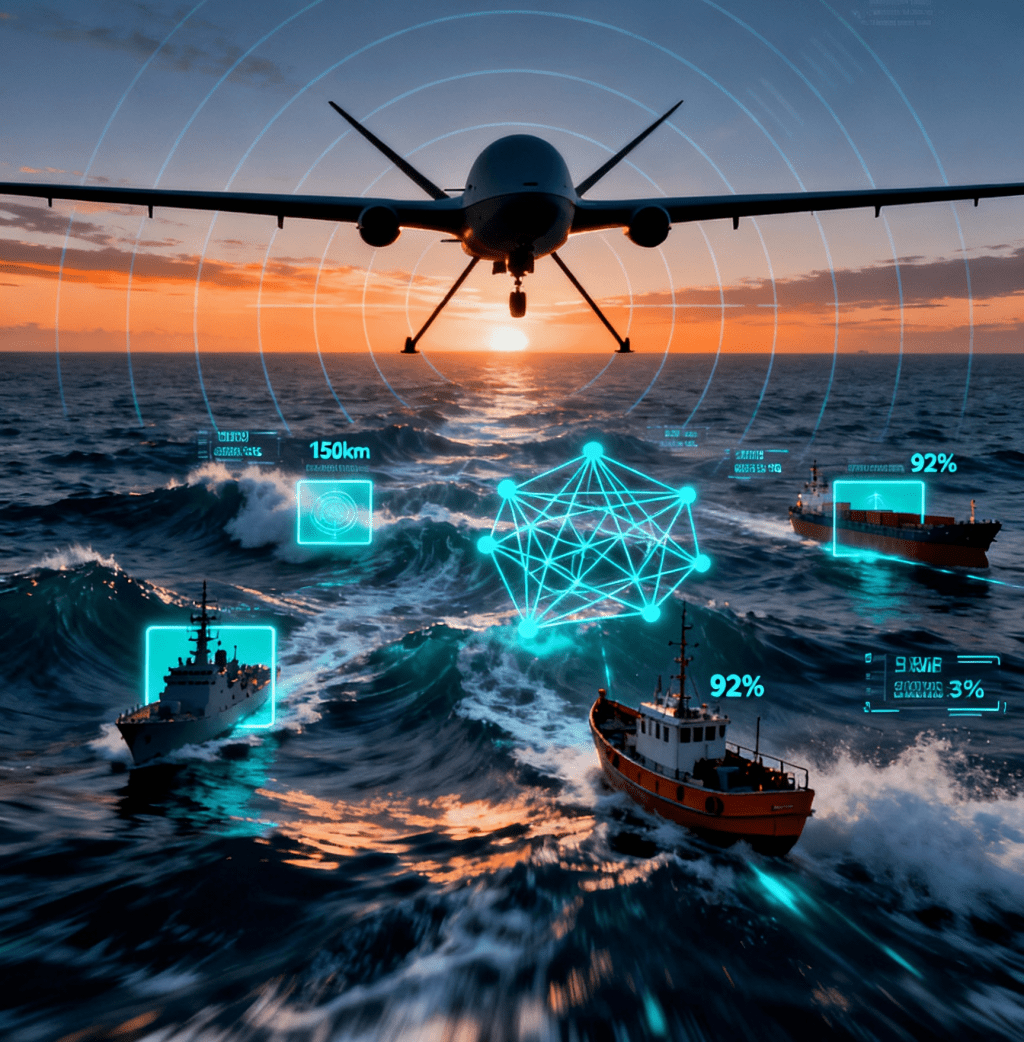
Yet, the true significance of Tahi and Rua lies in their role as a springboard for future developments. Their success paves the way for mass-scale autonomous surveillance, where fleets of USVs could operate in coordinated swarms to cover entire EEZs. Swarm technology, already under exploration by defence innovators, would enable multiple vessels to share sensor data, optimize patrol routes, and provide redundant coverage, dramatically scaling surveillance capacity. Such systems could integrate with underwater autonomous vehicles (AUVs) or aerial drones, creating a multi-domain network for comprehensive maritime monitoring. The NZDF’s investment in Tahi and Rua positions it to lead this evolution, potentially influencing global standards for uncrewed maritime operations.
Technical enhancements could further amplify their potential. Increasing propulsion efficiency to achieve higher speed, perhaps 10–15 knots would improve interception capabilities without sacrificing sustainability. Expanding sensor suites to include acoustic sensors or compact sonar could enable detection of underwater threats, such as submersibles used by smugglers. Cybersecurity remains a critical focus, as autonomous systems are vulnerable to hacking or jamming. Robust encryption and anti-jamming protocols will be essential to ensure operational integrity. Additionally, integrating Tahi and Rua with allied systems, such as Australia’s maritime surveillance networks, could enhance joint operations, fostering a regional uncrewed ecosystem.
Maintenance costs, while not publicly detailed, are likely low compared to crewed vessels. The renewable propulsion system eliminates fuel expenses, and AI-driven predictive maintenance could minimize downtime by anticipating component wear. Industry estimates for similar USVs suggest annual maintenance costs of NZ$50,000–150,000 per vessel, covering sensor calibration, software updates, and hull repairs. These costs are offset by the vessels’ operational efficiency and reduced crew requirements, aligning with NZDF’s goal of cost-effective modernization.
The broader implications of Tahi and Rua are profound. They challenge traditional maritime paradigms, demonstrating that small, autonomous platforms can deliver outsized strategic value. Their success could inspire other nations to adopt similar technologies, accelerating the global transition to uncrewed surveillance. For New Zealand, they reinforce national security, protect economic interests, and enhance regional influence. As the NZDF and Customs Service refine their operational doctrines, Tahi and Rua will serve as testbeds for scaling autonomy, potentially leading to a future where hundreds of USVs patrol the Pacific, seamlessly integrated with air, sea, and subsurface assets.
In conclusion, New Zealand’s Bluebottle USVs are more than cutting-edge tools; they are a bold step toward a future where autonomous systems dominate maritime surveillance. Tahi and Rua embody the convergence of renewable energy, AI, and advanced sensors, delivering immediate operational benefits while laying the groundwork for mass-scale, multi-domain surveillance networks. As New Zealand navigates the complexities of modern maritime threats, these vessels stand as beacons of innovation, guiding the way toward a safer, smarter, and more sustainable maritime frontier.
Key Sources:
– New Zealand Defence Force, “Defence and Customs Strengthen Maritime Security with Uncrewed Surface Vessels,” 2025.
– 1News, “New Uncrewed Vessels Unveiled to Help Tackle Transnational Crime,” April 15, 2025.
– Naval News, “New Zealand Introduces Bluebottle USVs for Maritime Security,” 2025.
– NZDF 2024 Year in Review.
– Ocius Technologies, Bluebottle USV Technical Specifications.


 Maritime Tales & Cutting Edge Sails
Leave a comment