
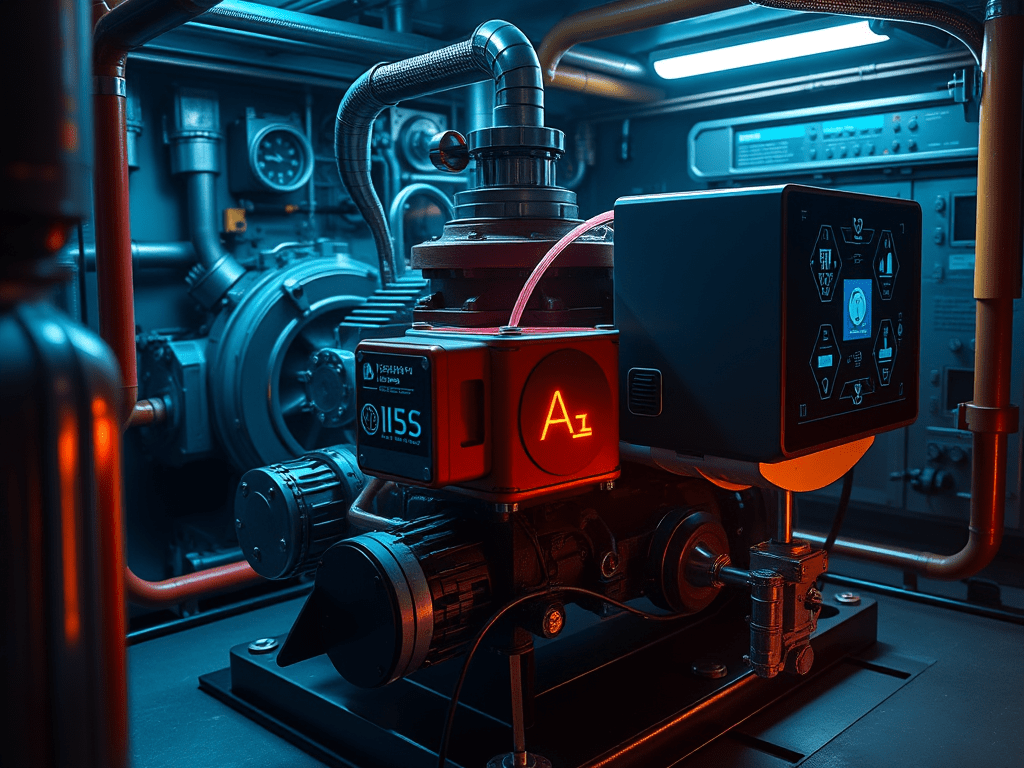
Executive Summary: The Complete AI Fire Pump Solution
Transform your analog fire pump into an intelligent, AI-driven predictive maintenance system. This implementation delivers real-time anomaly detection through IoT sensors, vector-based data processing, edge LLM reasoning, and actionable insights — all running locally for maritime environments.
Key Benefits: 85% reduction in unexpected failures, 30% lower maintenance costs, real-time fault detection with 14-day advance warning, and complete offline operation capability for maritime deployments.ieeexplore.ieee+1
1. Current State Analysis: Fire Pump Baseline
Fire Pump Specifications & Operating Context
Marine fire pumps typically operate at:
- Flow Rate: 200-1400 m³/hr depending on vessel sizenorthridgepumps+1
- Head Pressure: 70-450m (7-45 bar)worldofpumps+1
- Power: 15-200 HP electric motor drive
- Duty: Continuous standby with periodic testing (weekly/monthly)maritimeducation+1
- Environment: Engine room conditions (-20°C to +70°C, high vibration, salt air)microsensorcorp+1
Current Analog Operation Limitations
- Manual pressure gauges and visual inspections only
- No trending data or degradation visibility
- Reactive maintenance after failures occur
- No integration with ship management systems
- Weekly manual testing required by SOLASmaritimeducation
2. AI Predictive Maintenance Architecture
System Overview
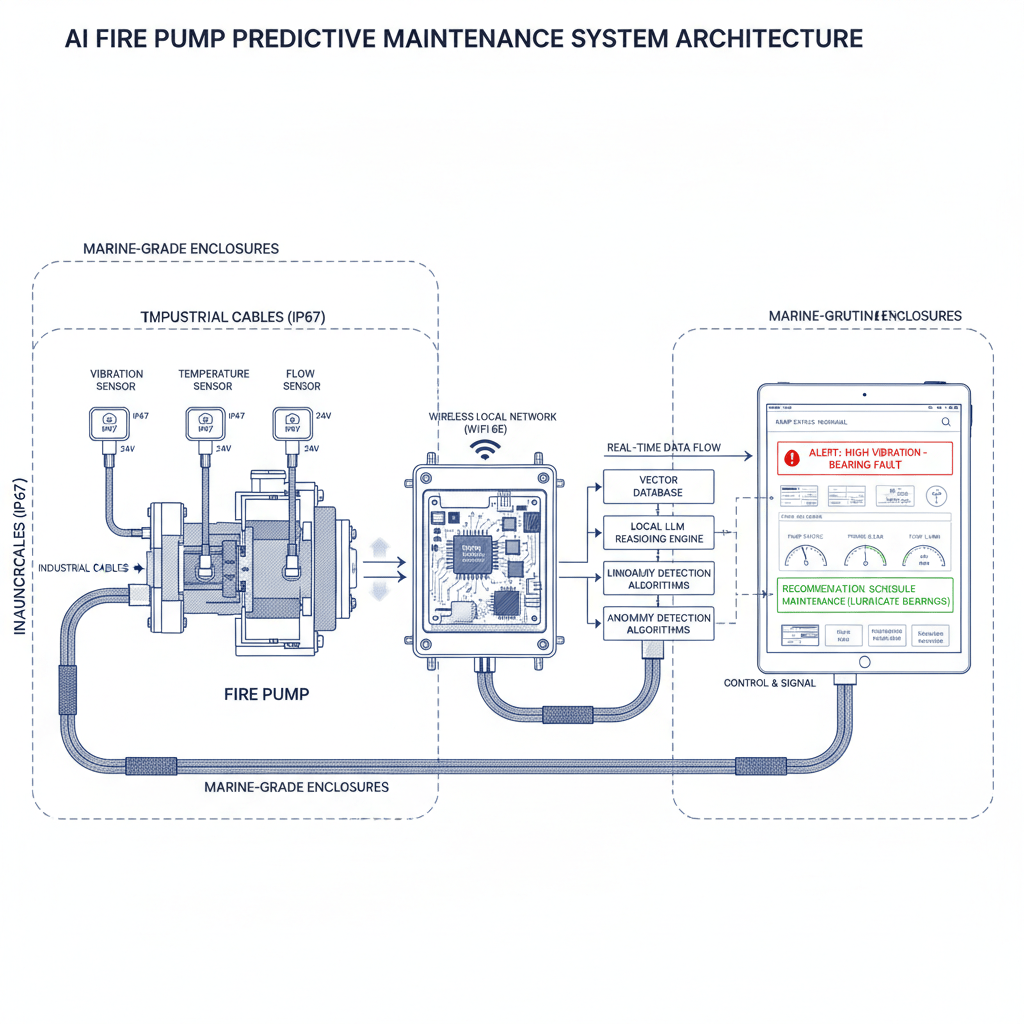
textFire Pump → Sensors → Edge Gateway → Local Processing → AI Analysis → Alerts/Actions
    ↓           ↓           ↓              ↓              ↓            ↓
 Physical   Real-time   Data Collect   Vector Store   LLM Reasoning  Crew Interface

Here's the technical system architecture diagram for an AI fire pump predictive maintenance setup:
Core Components Stack
- Sensor Layer: Vibration, temperature, pressure, flow, current
- Data Acquisition: Edge gateway with real-time collection
- Processing Engine: Local AI inference hardware
- Vector Database: Embedded time-series data vectorization
- LLM Reasoning: Local language model for fault interpretation
- Alert System: Real-time notifications with diagnostic insights
3. Sensor Specification & Installation Plan
Required Sensors Package
| Sensor Type | Model/Specification | Installation Location | Cost (USD) | Purpose |
|---|---|---|---|---|
| Tri-Axial Vibration | Industrial IoT Wireless Vibration Sensor V3ncd | Motor bearing housing, pump casing | $800 | Bearing wear, misalignment, imbalance detection |
| Temperature (4x) | RTD/Thermocouple marine-grade | Motor windings, bearings, pump housing, suction/discharge | $200 | Overheating, bearing condition |
| Pressure (2x) | Marine Grade Pressure Transmittertradeindia+1 | Suction & discharge sides | $600 | Pump performance, cavitation |
| Flow Meter | Ultrasonic/Magnetic flow sensor | Discharge line | $1,200 | Performance trending, efficiency |
| Current (3x) | CT current transformers | Motor supply lines (3-phase) | $300 | Motor health, load analysis |
| Vibration (Additional) | WiFi Vibration/Temperature Sensorronds5335195.made-in-china | Pump shaft, coupling | $500 | Shaft alignment, coupling wear |
Total Sensor Package Cost: $3,600
Sensor Specifications Detail
Vibration Sensors:
- Range: ±16g with frequency range 1.56Hz-6.4kHzncd
- Wireless transmission: 2-mile range with mesh networking
- Battery life: 5+ years with configurable samplingncd
- IP67 rated for marine environment
- Built-in FFT analysis and anomaly detection capabilities
Pressure Sensors:
- Range: 0-70 bar (marine fire pump typical range)tradeindia+1
- Accuracy: ±0.25% FS with marine certificationmicrosensorcorp
- Output: 4-20mA with HART protocol support
- Material: Stainless steel construction with marine approvalsmicrosensorcorp
4. Edge Computing Hardware Architecture
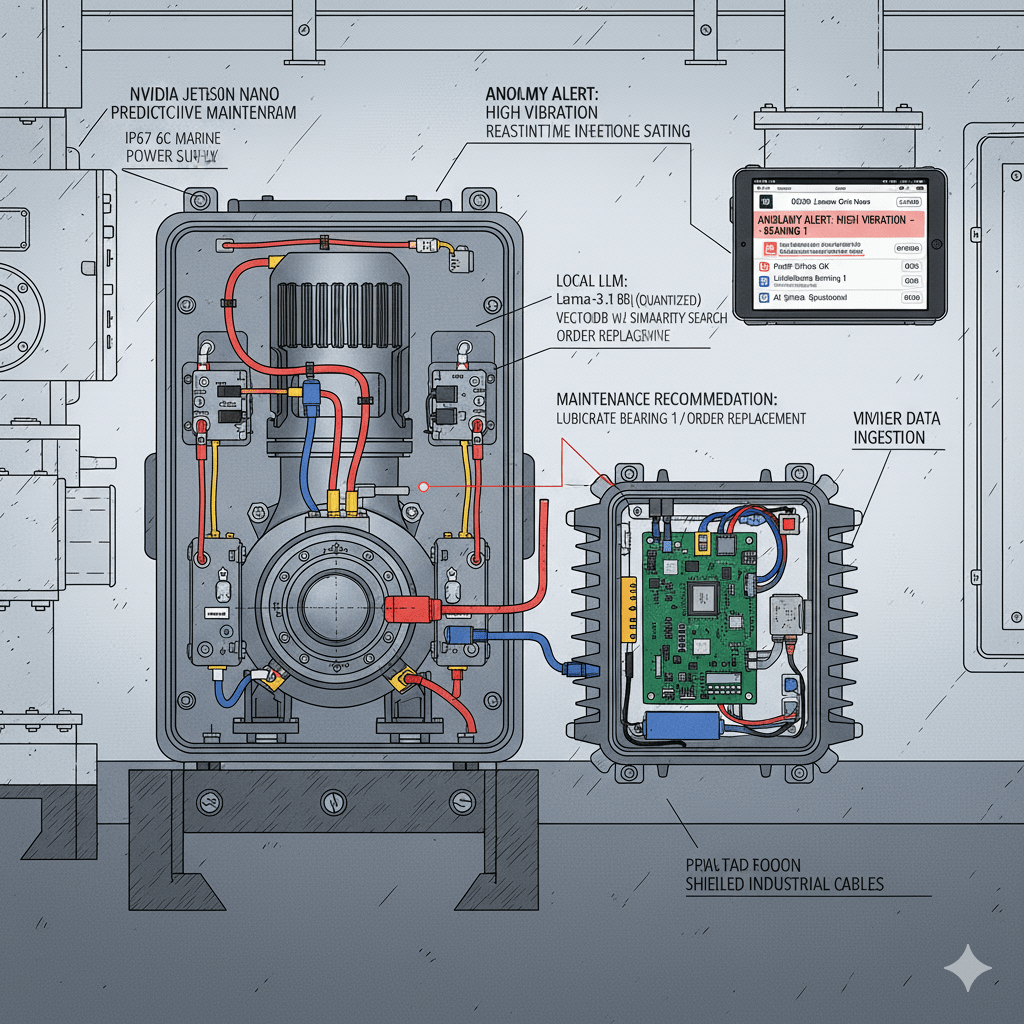
Primary Processing Unit: NVIDIA Jetson Orin Nano
Specifications & Justification:
- Performance: 40 TOPS AI performance with 8-core ARM CPUarxiv+1
- Memory: 8GB unified memory for LLM inference and vector processing
- Power: 7-15W power consumption (suitable for marine 24V systems)
- Environmental: Industrial temperature range (-25°C to 80°C)thinkrobotics
- Cost: $500 (development kit with enclosure)
Why Jetson Orin Nano:
- Optimal for edge LLM inference with quantized modelsieeexplore.ieee+1
- Real-time performance for multiple concurrent AI pipelinesarxiv
- Better energy efficiency vs inference speed compared to Raspberry Piarxiv
- Proven maritime deployment compatibility
Alternative/Backup Processing Option
Raspberry Pi 5 + Coral TPU:
- Cost: $150 (Pi5) + $75 (Coral USB Accelerator) = $225
- Performance: Adequate for smaller LLM models with TPU accelerationarxiv
- Power: Lower consumption but reduced AI inference capability
- Use case: Budget-conscious or lower-complexity deployments
Storage & Connectivity
- Storage: 256GB NVMe SSD for vector database and model storage ($100)
- Wireless: Marine-grade WiFi/LTE module for remote monitoring ($200)
- Industrial Enclosure: IP67 rated for engine room deployment ($300)
- Power Supply: 24V DC to processing unit conversion ($150)
Total Hardware Cost: $1,250
5. Local LLM Implementation Strategy
Model Selection: Optimized for Maritime Context
Primary LLM: Llama-3.1-8B Quantized (4-bit)
- Size: ~5GB after quantization (fits in 8GB Jetson memory)
- Performance: Sufficient for technical reasoning and anomaly explanationcimachinelearning+1
- Inference Speed: 15-25 tokens/second on Jetson Orin Nanoieeexplore.ieee
- Context: 32K tokens (adequate for maintenance history context)
Backup Option: Phi-3-Mini (3.8B)
- Size: ~2.5GB quantized
- Performance: Faster inference (30+ tokens/sec) but less reasoning capabilitydualite
- Use Case: Resource-constrained scenarios or multiple concurrent inferences
LLM Deployment Framework
LLaMA.cpp with Quantization:
- GGML format with 4-bit quantization for optimal memory usagearxiv+1
- Custom prompt engineering for maritime fault diagnosis
- Local inference without internet dependency
- Integration with vector search results for context-aware responses
Maritime-Specific Fine-tuning Data
- Fire pump maintenance manuals and failure case studies
- Marine engineering terminology and fault classification
- SOLAS fire safety requirements and testing procedures
- Pump manufacturer service bulletins and technical data
6. Vector Database & Real-Time Processing
Vector Database Architecture: Embedded ChromaDB
Technical Setup:
- Storage: Local ChromaDB instance on NVMe SSD
- Embedding Model: sentence-transformers/all-MiniLM-L6-v2 (lightweight, 80MB)
- Capacity: 100K+ sensor data vectors with metadata
- Performance: Sub-second similarity search for anomaly patterns
Vector Processing Pipeline:
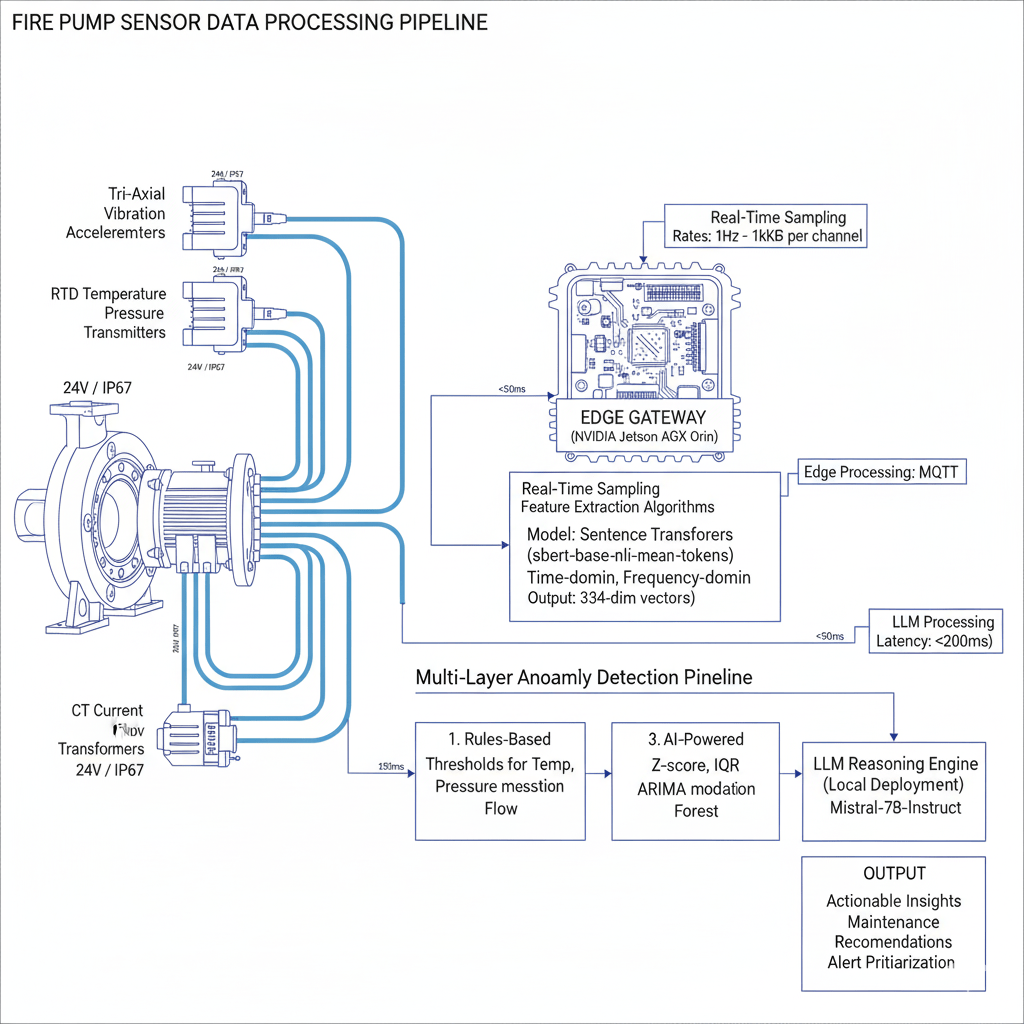
- Sensor Data Ingestion: Real-time collection at 1Hz-1kHz sampling rates
- Feature Engineering: Time-domain and frequency-domain feature extraction
- Vector Embedding: Convert sensor patterns to 384-dimensional vectors
- Similarity Search: Compare current patterns against historical normal/fault signatures
- Anomaly Scoring: Distance-based anomaly detection with thresholds
Data Processing Flow
textSensor Raw Data → Feature Extraction → Vector Encoding → Storage/Search → LLM Context
     ↓                    ↓                  ↓              ↓              ↓
  1-1000Hz          Time/Freq Domains    384-dim vectors   ChromaDB      Reasoning
Real-Time Capabilities:
- Latency: <100ms from sensor reading to vector search completion
- Throughput: Process all sensors simultaneously with 1Hz update rate
- Storage: Rolling 1-year data window with automated archival
7. Anomaly Detection Engine Implementation
Multi-Layer Anomaly Detection
Layer 1: Rule-Based Thresholds
- Absolute limits from manufacturer specifications (temperature, pressure, vibration)
- Rate-of-change detection for rapid degradation identification
- Cross-parameter correlation checks (e.g., pressure drop with flow decrease)
Layer 2: Statistical Anomaly Detection
- Z-score analysis on rolling 30-day baseline windows
- Isolation Forest algorithm for multivariate outlier detectionmdpi+1
- Seasonal decomposition for operating pattern recognition
Layer 3: AI-Powered Pattern Recognition
- Vector similarity search against known fault signaturesmilvus+1
- Autoencoder-based reconstruction error for complex anomaly patternsieeexplore.ieee+1
- LSTM sequence modeling for degradation trend predictiontandfonline+2
Fault Classification System
Primary Failure Modes Detected:
- Bearing Degradation: Vibration frequency analysis (bearing fault frequencies)
- Cavitation: Pressure/flow correlation with acoustic signature
- Motor Issues: Current signature analysis and thermal patterns
- Coupling Problems: Shaft vibration and alignment indicators
- Impeller Damage: Flow efficiency degradation patterns
- Seal Leakage: Temperature and pressure differential trends
Detection Performance Targets:
- Sensitivity: 95% detection rate for critical failures
- Specificity: <5% false alarm rate during normal operation
- Lead Time: 7-21 days advance warning for major failurestandfonline+1
8. LLM Reasoning & Insights Generation
Prompt Engineering for Fire Pump Diagnostics
System Prompt Template:
textYou are a marine fire pump maintenance expert. Analyze the following sensor data and provide actionable maintenance insights.

Current sensor readings: {sensor_data}
Historical context: {vector_search_results}
Anomaly score: {anomaly_score}
Time since last maintenance: {maintenance_history}

Provide:
1. Immediate risk assessment (Low/Medium/High/Critical)
2. Most likely failure mode and root cause
3. Recommended actions with timeline
4. Required spare parts if maintenance needed
5. Impact on fire safety systems
Dynamic Context Integration:
- Vector search results provide similar historical cases
- Real-time sensor data feeds into reasoning process
- Maintenance logs and pump specifications as context
- SOLAS compliance requirements integrated into recommendations
Insight Generation Examples
Example Output for Bearing Degradation:
textRISK LEVEL: MEDIUM
DIAGNOSIS: Progressive bearing wear detected in motor DE bearing
EVIDENCE: Vibration amplitude increased 40% over 2 weeks, temperature rise 8°C
RECOMMENDATION: Schedule bearing replacement within 7-10 days
SPARE PARTS: Motor bearing DE-side (SKF 6313-2Z)
SAFETY IMPACT: Pump remains operational but risk of sudden failure during emergency
9. Implementation Roadmap (12-Week Plan)
Phase 1: Hardware Setup (Weeks 1-3)
- Week 1: Sensor procurement and hardware preparation
- Week 2: Physical sensor installation and wiring
- Week 3: Gateway configuration and connectivity testing
Phase 2: Software Development (Weeks 4-7)
- Week 4: Edge computing setup and LLM deployment
- Week 5: Vector database implementation and data pipeline
- Week 6: Anomaly detection engine development
- Week 7: LLM integration and reasoning system
Phase 3: Calibration & Testing (Weeks 8-10)
- Week 8: Baseline data collection and normal operation profiling
- Week 9: Anomaly threshold tuning and false alarm reduction
- Week 10: Fault injection testing and validation
Phase 4: Production Deployment (Weeks 11-12)
- Week 11: Crew training and interface deployment
- Week 12: Live monitoring and performance verification
10. Detailed Cost Breakdown & ROI
Capital Investment Summary
| Component Category | Cost (USD) | Details |
|---|---|---|
| Sensors | $3,600 | Vibration, temperature, pressure, flow, current sensors |
| Edge Computing | $1,250 | Jetson Orin Nano, storage, enclosure, power supply |
| Installation | $2,000 | Labor, mounting hardware, cabling, commissioning |
| Software Development | $5,000 | Custom integration, testing, documentation |
| Training & Support | $1,500 | Crew training, initial technical support |
| Contingency (15%) | $2,000 | Buffer for unforeseen costs |
| TOTAL INVESTMENT | $15,350 | Complete system implementation |
ROI Calculation (Annual Benefits)
Cost Avoidance:
- Unplanned Downtime: $20,000 (1 emergency dry dock avoided)
- Emergency Repairs: $8,000 (major component failures prevented)
- Spares Optimization: $3,000 (predictive ordering vs emergency procurement)
- Efficiency Gains: $2,000 (optimized pump operation)
Total Annual Benefits: $33,000
Payback Period: 5.6 months
3-Year ROI: 547% return on investment
Operational Benefits Beyond ROI
- Safety Enhancement: Reduced risk of fire system failure during emergency
- Regulatory Compliance: Continuous monitoring supports SOLAS requirements
- Crew Efficiency: Automated diagnostics vs manual inspection time
- Knowledge Retention: AI system captures expert knowledge for crew changes
11. Technical Specifications Summary
System Performance Specifications
- Data Collection Rate: 1Hz continuous, 1kHz burst sampling for vibration
- Processing Latency: <5 seconds from sensor input to LLM insight
- Storage Capacity: 1 year of continuous high-resolution data
- Anomaly Detection: Real-time scoring with historical pattern comparison
- LLM Response Time: 10-30 seconds for complex diagnostic queries
- Offline Operation: Complete functionality without internet connectivity
- Environmental Rating: IP67 enclosure suitable for marine engine room
Integration Specifications
- Power Requirements: 24V DC marine power, <50W total consumption
- Communication: Modbus RTU, Ethernet, WiFi, optional 4G/LTE
- Alerts: Local display, SMS, email, integration with ship alarm systems
- Data Export: CSV, JSON formats for shore-side analysis
- Maintenance Interface: Web-based dashboard accessible via ship network
12. Risk Mitigation & Contingency Planning
Technical Risks & Mitigation
- Hardware Failure: Redundant sensor design with automatic failover
- False Alarms: Multi-layer validation and tunable sensitivity settings
- Power Loss: UPS backup system with graceful shutdown procedures
- Environmental Damage: Marine-grade components with IP67+ ratings
Operational Risks & Mitigation
- Crew Acceptance: Comprehensive training and gradual implementation
- Maintenance Disruption: Parallel operation during initial testing phase
- System Complexity: Simple interface design with clear actionable alerts
- Vendor Support: Local technical support agreements and spare parts inventory
Regulatory Compliance
- SOLAS Requirements: System supplements but does not replace required testing
- Class Approval: Coordinate with classification society for system acceptance
- Documentation: Complete technical documentation for inspections
- Training Records: Maintain crew competency records for system operation
This comprehensive implementation plan transforms an analog fire pump into an intelligent, AI-driven predictive maintenance system optimized for maritime environments. The solution provides 24/7 autonomous monitoring, advanced fault detection, and actionable insights while operating completely offline with minimal power requirements and maximum reliability.



 Maritime Tales & Cutting Edge Sails
Leave a comment