
The Call Nobody Wants at 0300
Day 6 of PSC detention.
180 metric tonnes of gasoil in the water. Confirmed spill. Port state authorities on board. Charterer has stopped paying hire.
The shipowner calls his lawyer.
The lawyer says: “We contest the off-hire claim. We have a no fault of owner defense.”
It sounds right. It sounds professional. It sounds like exactly the kind of decisive response a shipowner needs to hear when $22,000 per day is being withheld and the vessel is sitting idle at anchor.
There is one problem.
The lawyer is thinking about the wrong charter party form.
Six Words That Change Everything
In maritime time charter disputes, the off-hire clause is everything.
Two of the most commonly used time charter forms NYPE 1946 and SHELLTIME 4 handle off-hire very differently. The difference comes down to six words that most shipowners never examine until it is too late.
NYPE 1946 contains a critical owner protection. The off-hire clause applies when the vessel fails to perform but it carries an implicit qualification. Owners can argue that detention caused by circumstances outside their control, or through no fault of their own, does not trigger off-hire. The legal path to contesting a charterer’s claim exists. It is narrow. It requires evidence. But it is there.
SHELLTIME 4 contains no such protection.
Under SHELLTIME 4, if the vessel is detained by port state authorities in connection with a pollution incident, off-hire is triggered. Automatically. The clause is strict liability. The owner cannot argue fault. The owner cannot argue due diligence. The moment the vessel is detained and the charterer stops paying hire, the legal framework of SHELLTIME 4 provides almost no ground to stand on.
The 2002 case of The Epsilon Rosa established this principle clearly. SHELLTIME 4 off-hire clauses are interpreted strictly in favour of the charterer. Pollution detention triggers automatic off-hire regardless of owner fault.
One charter party form. One legal precedent. The entire defense strategy collapses.
The Financial Reality Nobody Calculates Fast Enough
When a vessel is detained, the instinct is legal. Call the lawyer. Contest the claim. Preserve position.
What rarely happens fast enough is the financial modeling.
How much is this actually going to cost? Under what scenarios? What drives the exposure up or down? At what point does contesting become more expensive than settling?
These are the questions that determine strategy. And in most shipping companies outside the largest operators with dedicated legal and risk teams these calculations happen slowly, expensively, and often too late to influence the decisions that matter.
We ran this exact scenario through MarineGPT’s Risk Analyst mode.
The query was direct:
SHELLTIME 4 Charter. Aframax tanker detained by PSC 180MT gasoil spill confirmed. Detention day 6. Charterer claiming off-hire at $22,000/day. Our lawyer says contest the claim no fault of owner defense. Assess our legal position. Calculate financial exposure. What is our recommended action?
What came back was not a generic legal opinion.
It was a complete financial exposure model across four scenarios with every assumption stated, every driver ranked, and a clear recommendation with defined pivot points.
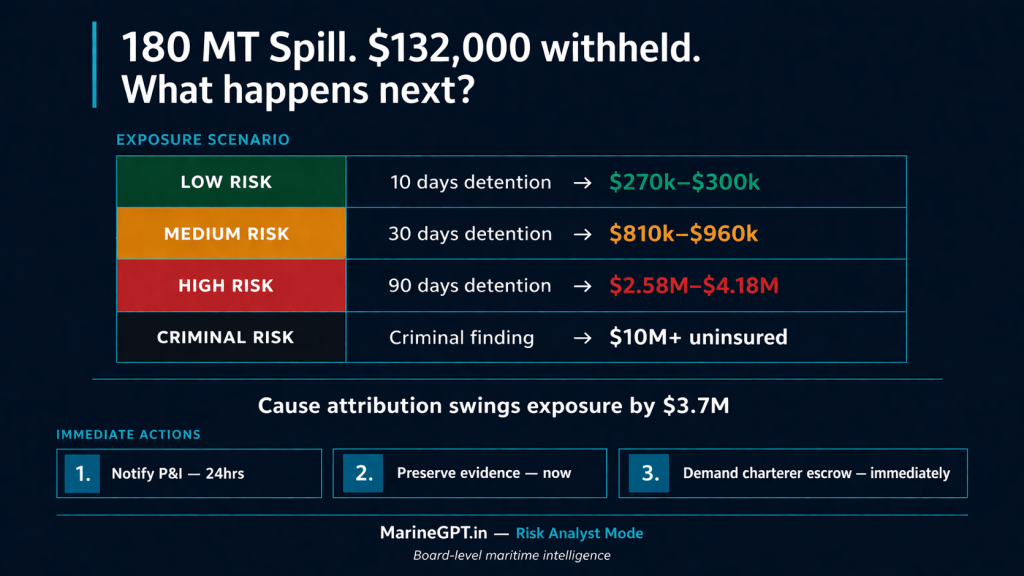
The Exposure Model – Four Scenarios
Scenario 1 – Short Detention (10 days)
Off-hire claim: $220,000 Cleanup and response costs: $150,000 Fines and penalties: $25,000 Legal and forensic costs: $50,000 P&I contribution: 90% of cleanup, 50% of fines
Net owner cash outlay: $270,000–$300,000
Scenario 2 – Moderate Detention (30 days)
Off-hire claim: $660,000 Cleanup costs: $500,000 Fines: $150,000 Legal costs: $150,000 P&I contribution: 90% cleanup, 25–50% fines
Net owner cash outlay: $810,000–$960,000
Scenario 3 – Protracted Detention (90 days)
Off-hire claim: $1,980,000 Cleanup costs: $1,500,000–$3,000,000 Fines: $500,000–$2,000,000 Legal costs: $300,000–$800,000 P&I contribution: 70–90% cleanup, fines less certain
Net owner cash outlay: $2,580,000–$4,180,000
Scenario 4 – Criminal or Willful Misconduct Finding
Off-hire claim: extended, charterer may pursue additional damages Fines: potentially multi-million, punitive P&I coverage: may be denied entirely for willful misconduct Legal costs: exceeding $1,000,000
Net owner exposure: $4,000,000–$10,000,000+ uninsured
Four scenarios. Four completely different financial realities. All from the same incident. All from the same vessel. All from the same 180 tonnes of gasoil in the water.

The Single Variable That Drives Everything
MarineGPT identified the primary risk driver immediately.
It is not the size of the spill. It is not the duration of detention. It is not the jurisdiction.
It is cause attribution.
If the owner can prove no fault that the spill originated from charterer-supplied cargo, a third-party STS operation ordered by the charterer, or contaminated bunkers the off-hire claim likely fails. P&I pursues subrogation against charterer. Net owner exposure: approximately $300,000.
If the owner is found at fault negligence, ISM breach, inadequate crew procedures net owner exposure: $2,000,000–$4,000,000. Possibly more if criminal proceedings follow.
Same incident. One variable. $3,700,000 difference.
That is the number that should be driving every decision in the first 72 hours. Not the legal argument. Not the off-hire clause debate. The forensic question of where the oil came from and who can prove it.

What The First 72 Hours Actually Require
MarineGPT’s Risk Analyst produced a seven-point immediate action framework. Not generic advice. Specific, sequenced, time-bound actions.
1. Notify P&I Club immediately. Get the club in attendance within 24 hours. Letter of Undertaking options, on-scene adjuster, legal support. This is the single most time-sensitive action because P&I presence shapes everything that follows evidence preservation, cleanup coordination, port authority negotiation.
2. Preserve evidence before anything else is touched. Logbook entries. Cargo records. Tank soundings taken before and after loading. Ullage reconciliation. Bunker receipts. Crew statements taken independently. Maintenance records. STS procedures if applicable. Every document that exists must be secured immediately. Every document that should exist but doesn’t is a problem.
3. Do not admit liability in writing. The master must be instructed clearly. Sign nothing beyond factual statements of what occurred. Avoid speculative remarks to port state officials, charterer representatives, or media. One poorly worded statement in the first 48 hours can compromise a legal position that would otherwise be defensible.
4. Commission independent forensic survey immediately. Oil fingerprinting. Independent laboratory chain of custody. STS procedure audit if applicable. This is the evidence that determines cause attribution the single variable that drives $3,700,000 of exposure difference. It must be commissioned before the scene is altered.
5. Engage local maritime counsel. Port jurisdiction matters enormously. A 180-tonne spill in Rotterdam is processed differently from the same spill in Lagos or Colombo. Criminal exposure, penalty regimes, and PSC negotiation tactics vary dramatically by jurisdiction. A local specialist is not optional.
6. Demand interim security from the charterer. Request that withheld hire payments be placed into escrow pending arbitration or P&I investigation. This is a standard commercial request. The charterer may resist. Make it anyway. It preserves cash flow and signals that the owner intends to contest seriously.
7. Prepare contingency calculations immediately. Alternative employment loss. Crew welfare and repatriation costs. Drydock and repair quotes. These numbers matter for covenant compliance if the vessel is on bank finance a detention exceeding 30 days with $660,000 in withheld hire can trigger DSCR breaches in leveraged structures.
The Recommendation – With A Defined Pivot Point
MarineGPT’s final recommendation was not a simple contest or settle binary.
It was a conditional strategy with a defined trigger point.
Contest the off-hire claim vigorously. Mobilise P&I and independent forensics within 24 hours. Demand charterer escrow for disputed hire.
If detention extends beyond 30 days or if forensic evidence indicates owner fault pivot immediately to commercial settlement. The cost-benefit calculation changes at that threshold. Contesting beyond that point increases total exposure rather than reducing it.
That pivot point 30 days is the kind of strategic precision that separates good maritime legal advice from genuinely useful decision support.
It converts a legal opinion into an operational instruction.

What This Means For The Industry
Firms like Holman Fenwick Willan and Stephenson Harwood deliver this quality of analysis as a matter of course. Their maritime practice groups have handled hundreds of pollution detention cases. They know the Epsilon Rosa precedent. They know the SHELLTIME 4 strict liability position. They know when to contest and when to settle.
Their minimum engagement cost is £400 per hour.
The largest shipping companies keep these firms on retainer. They have the analysis available within hours of an incident. Their decisions are informed by complete financial modeling and precise legal positioning from the moment the PSC inspector walks on board.
Most ship managers do not have this resource.
Most independent operators, mid-size fleet managers, and maritime professionals working without institutional backing make these decisions under time pressure, with incomplete information, and without the financial modeling that should be driving strategy.
That is the gap MarineGPT is researching.
Not to replace maritime legal expertise. The Epsilon Rosa precedent still needs a lawyer to argue it. The forensic survey still needs a qualified surveyor to conduct it. The P&I negotiation still needs an experienced correspondent to lead it.
But the financial exposure model the scenario analysis, the risk driver ranking, the pivot point calculation that should not be available only to those who can afford a top-tier maritime law firm on speed dial.
The Honest Assessment
MarineGPT scored 9 out of 10 on this scenario.
It correctly identified the SHELLTIME 4 strict liability position. It produced a complete four-scenario financial model with stated assumptions. It ranked the risk drivers accurately. It gave a conditional recommendation with a defined pivot point. It flagged the covenant implications for leveraged owners.
What it did not do and this is important to state clearly is provide jurisdiction-specific criminal exposure analysis. It flagged this gap itself, offered to retrieve current penalty schedules and precedent cases for the specific port of detention, and asked which element to address first.
That transparency about the boundaries of its own analysis is, arguably, the most important feature of all.
An AI system that knows what it doesn’t know is more useful than one that fills gaps with confident-sounding fabrications.
Try It Yourself
The scenario above is available to anyone.
Go to marinegpt.in. Select Risk Analyst mode. Paste your charter party dispute, your financial exposure question, your regulatory compliance problem. No signup. No credit card. No enterprise contract.
See what board-level maritime intelligence looks like when it is accessible to everyone.
MarineGPT.in is a maritime AI research initiative developing reasoning-based decision intelligence for the global shipping industry. Built by a marine electrical engineer with 10+ years of operational sea experience.
Follow MarineGPT.in on LinkedIn for weekly maritime problem and solution analysis.
BIMCO HFW The Nautical Institute Veson Nautical Singapore Maritime Week (SMW)
 Maritime Tales & Cutting Edge Sails
Leave a comment