

The Ship That Was Perfectly Planned but Could Not Sail
A vessel can possess an optimised voyage plan, accurate weather routing, an efficient fuel strategy and a precise predicted arrival time and still fail to complete the voyage. The limiting factor is no longer the quality of planning but it is residual physical capability.
The maritime industry has become highly sophisticated at determining where a ship should go and how efficiently it should operate. Weather routing, voyage optimisation, trim advice, emissions management and fleet scheduling now operate at high levels of maturity. These capabilities, however, rest on a silent assumption: that the physical vessel will remain able to execute the plan.
A single failure in propulsion, electrical power, steering or associated control systems can invalidate the entire optimisation chain. When that happens, the commercial and operational consequences are immediate: loss of control of the voyage, off-hire, emergency response, schedule disruption and secondary commercial exposure.
This is the central paradox. The industry is advancing rapidly in predicting where a ship should go, while remaining comparatively weaker at predicting whether the ship will remain capable of getting there.

A vessel can possess an optimised voyage plan, accurate weather routing, an efficient fuel strategy and a precise predicted arrival time and still fail to complete the voyage. The limiting factor is no longer the quality of planning but it is residual physical capability.
The maritime industry has become highly sophisticated at determining where a ship should go and how efficiently it should operate. Weather routing, voyage optimisation, trim advice, emissions management and fleet scheduling now operate at high levels of maturity. These capabilities, however, rest on a silent assumption: that the physical vessel will remain able to execute the plan.
A single failure in propulsion, electrical power, steering or associated control systems can invalidate the entire optimisation chain. When that happens, the commercial and operational consequences are immediate: loss of control of the voyage, off-hire, emergency response, schedule disruption and secondary commercial exposure.
This is the central paradox. The industry is advancing rapidly in predicting where a ship should go, while remaining comparatively weaker at predicting whether the ship will remain capable of getting there.
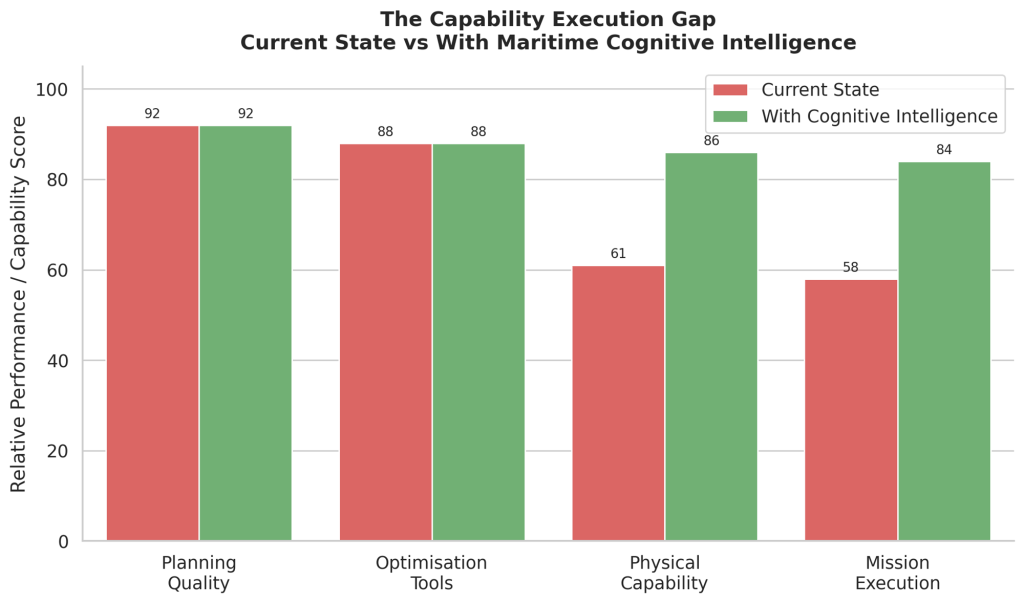
Two recent investigations illustrate the point with clarity. In the Gaschem Homer case, an electrical blackout produced simultaneous loss of propulsion and steering. In the Dali investigation, an electrical fault initiated a sequence of blackouts that again resulted in loss of both propulsion and steering. In both cases, the voyage was no longer under the operator’s control.
These cases demonstrate why conventional equipment-health monitoring is necessary but insufficient. The decisive operational question is:
What is the probability that a developing condition will compromise a critical ship function, when could that occur, and does sufficient time remain to intervene?
The remainder of this article addresses that question.
What Actually Makes a Ship Unable to Sail
A ship does not become operationally unavailable simply because one piece of equipment fails. The decisive question is whether the failure removes a critical function required to execute the intended voyage safely.
There is no universal IMO list that designates identical equipment as critical on every vessel. Criticality is consequence-driven and partly ship-, system- and context-dependent. Maritime Cognitive Intelligence therefore classify equipment through the function it supports rather than through equipment name alone.
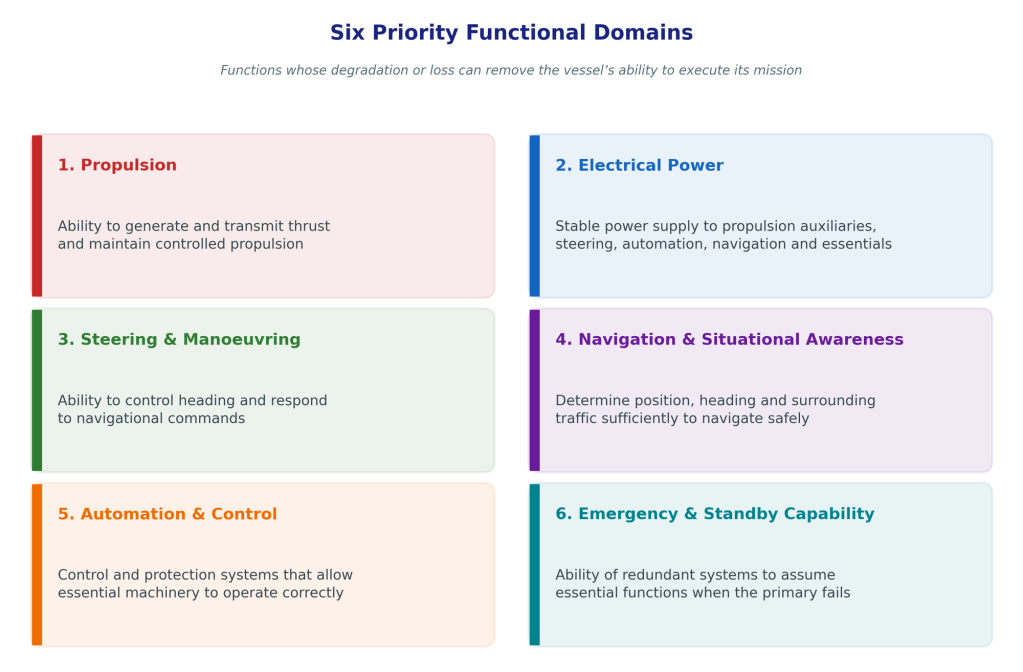
The Gaschem Homer and Dali cases show that electrical configuration and power-management logic can remove both propulsion and steering without any mechanical failure of the main engine or rudder. The Al Messilah and FMG Nicola investigations demonstrate that mission failure can originate in the protection, sensing or control layer.
Hardware redundancy does not automatically equal operational redundancy. Cognitive systems must assess whether the backup is available, healthy, accessible and usable by the crew at that moment. Navigation equipment requires contextual criticality. Emergency systems present a further paradox: they may never operate until the moment they are required.
The purpose of advanced analytics is not to predict every equipment failure. It is to identify the relatively small number of degradation paths capable of progressing into loss of critical function and to provide sufficient actionable lead time to intervene.
From Equipment Health to Mission Health
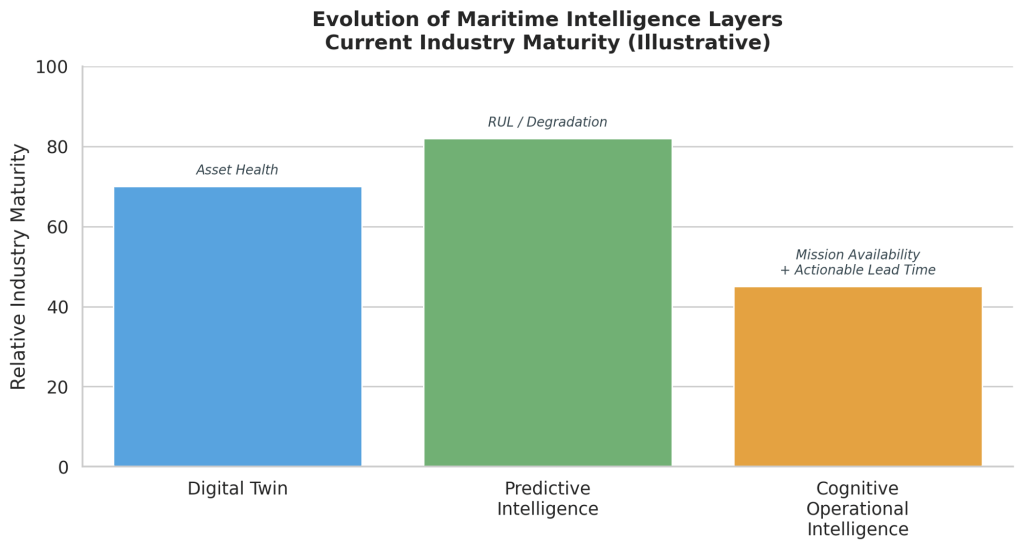
The digital twin is an important advance in maritime predictive maintenance. Its limitation is not technical incapacity. Its limitation is the question it is normally asked to answer.
Remaining Useful Life is necessary but insufficient.
A conventional system may establish that an exhaust valve is degrading and that its estimated RUL is reducing. That is useful engineering information. It does not answer the operational question:
Will this degradation prevent the ship from completing its next voyage, and when must action be taken to prevent that outcome?
RUL describes remaining component life. It does not describe remaining mission assurance.
A more operationally relevant measure is Actionable Lead Time, the interval between the earliest reliable identification of an emerging failure trajectory and the latest practical moment at which intervention can still prevent unacceptable loss of capability.
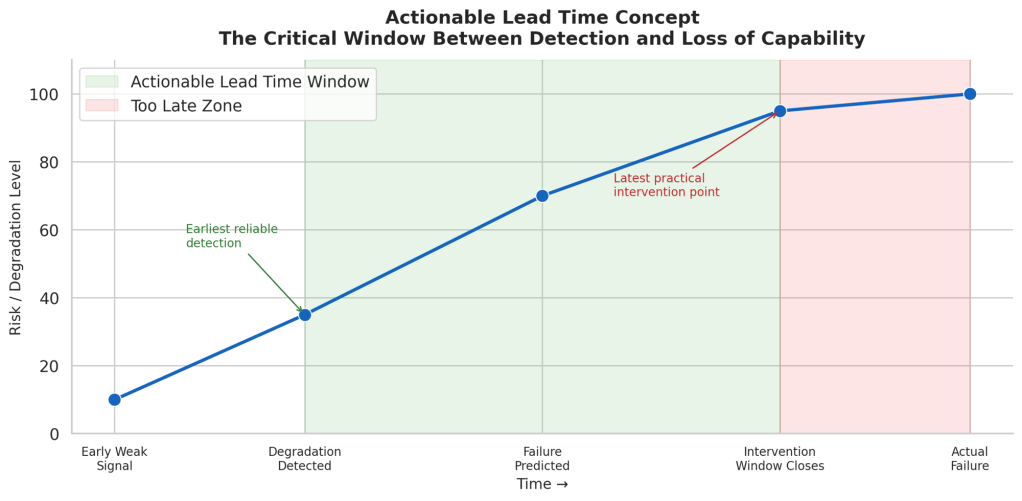

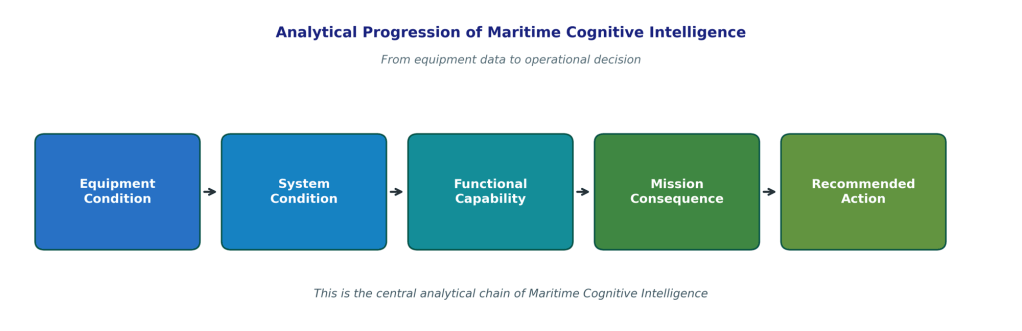
This shift in perspective is decisive. The digital twin predicts the future state of the machine. The cognitive operational layer predicts the future capability of the ship and whether sufficient time remains to protect that capability.
The ultimate vessel-level metric becomes Mission Availability, an expression of residual capability across the critical functions, weighted by current configuration, redundancy, voyage phase and intervention opportunity.
In short: the digital twin predicts the future state of the machine. The cognitive operational layer predicts the future capability of the ship. That is the necessary step beyond the digital twin.
In short: the digital twin predicts the future state of the machine. The cognitive operational layer predicts the future capability of the ship. That is the necessary step beyond the digital twin.
Where Advanced Analytics Must Be Concentrated
Priority must follow consequence, propagation potential, detectability and residual intervention opportunity. Six domains warrant concentrated attention.


Electrical power functions as a common-cause risk beneath multiple critical functions. Steering presents cases where hardware redundancy does not equal operational redundancy. Navigation, automation and emergency systems require equally rigorous treatment, but their criticality is more strongly modulated by context.

The ultimate analytical target is not the number of equipment alarms prevented. It is the number of occasions on which the system provides sufficient actionable lead time to preserve a critical vessel function and allow the ship to sail as planned.
The Economics of Mission Assurance
The economic case must be constructed with discipline. The decisive question is whether the system reduces the probability and severity of events that remove the vessel’s ability to execute its planned mission.
Documented investigations illustrate the scale. In the Atlantic Huron case, combined vessel and pier damage reached approximately USD 2.2 million. In the Maunalei case, vessel damage was estimated at USD 3.03 million. These figures capture only direct physical damage and exclude off-hire, emergency response, schedule disruption and commercial consequences.
A transparent benefit–cost structure is therefore required:

The economic rationale for Maritime Cognitive Intelligence is the protection of operational continuity.
Implementation Architecture
The transition from equipment-level monitoring to mission-level assurance does not require replacement of existing systems. It requires a coherent architecture that connects already-available data streams into a reasoning layer.

Three design principles are non-negotiable: data integrity as a first-class input; the knowledge graph of system dependencies as an engineering artefact; and final decision authority remaining with qualified human operators.
The New Maritime KPI
The maritime industry has made substantial progress in predicting where a vessel should go, how efficiently it should operate, and how individual machines are degrading. These advances remain incomplete if the physical vessel cannot execute the optimised plan.
Conventional predictive maintenance and digital-twin approaches answer an equipment-level question: what is the condition of this component, and how long is it likely to last?
The operational question that ultimately determines voyage success is different:
What is the probability that the vessel will retain the critical functions required to complete its intended mission, and does sufficient actionable lead time remain to intervene?
Maritime Cognitive Intelligence addresses this gap by elevating the analytical focus from asset health to mission capability. Its principal outputs — Mission Availability and Actionable Lead Time — translate engineering insight into operational decision support.
The future performance question for a commercial vessel must therefore shift. It is no longer sufficient to ask only how efficiently the ship operated. The more consequential question is:
How confident are we that the ship will remain capable of executing its next mission?
That is the transition from predictive maintenance to Maritime Cognitive Intelligence.



Leave a comment